
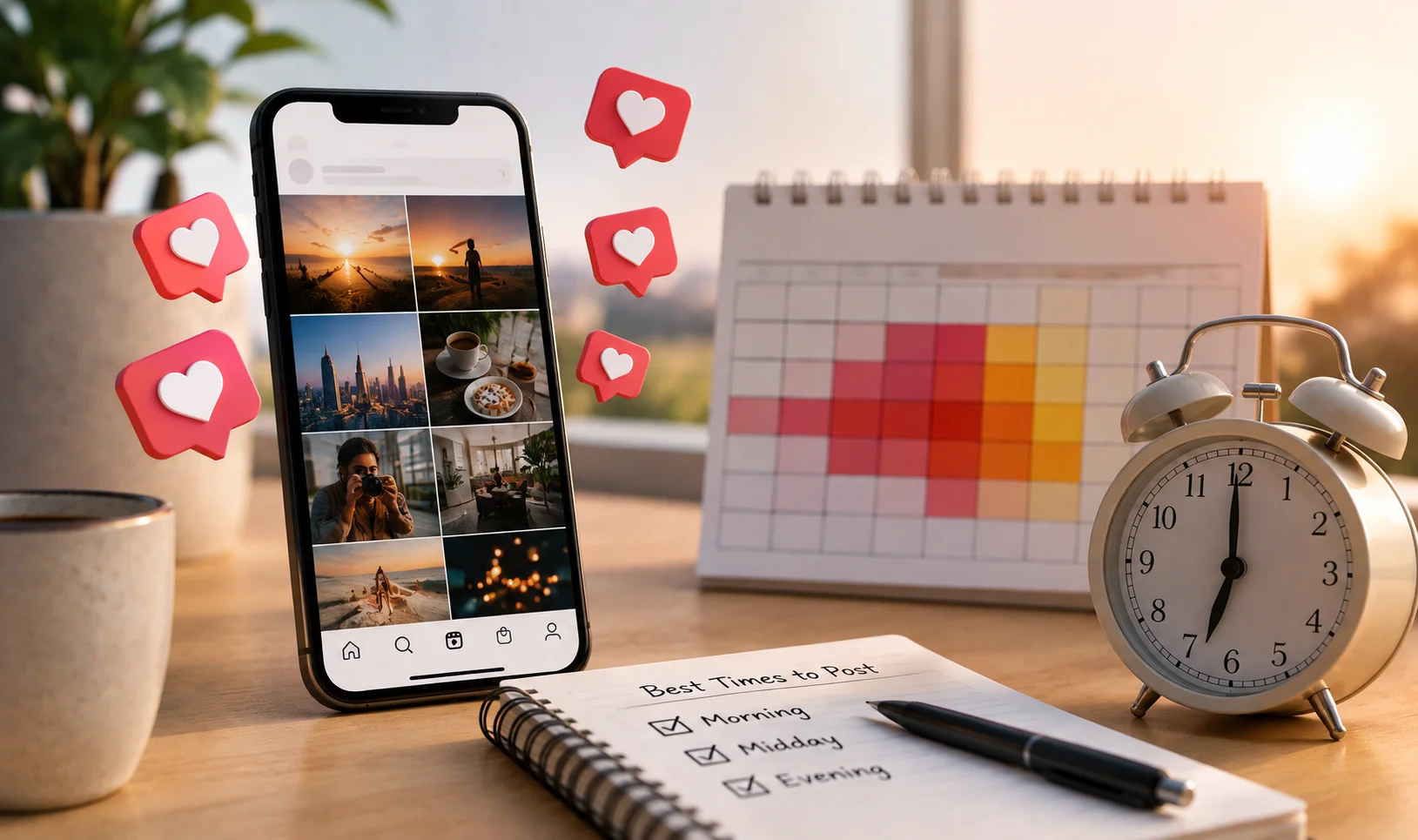
Best times to post on Instagram 2026
Timing is one of the most underrated factors in Instagram success. Two nearly identical posts, published just a few hours apart, can perform completely differently simply because one caught the audience while they were scrolling and the other did not. While content quality will always matter most, posting at the right time gives that quality content the best possible chance to be seen quickly, which directly affects how many likes it accumulates in the crucial early hours after publishing.Best times to post on Instagram 2026
This guide breaks down the research backed best times to post on Instagram in 2026, explains why timing affects likes specifically, and shows you how to find the exact optimal posting schedule for your own unique audience rather than relying on generic advice alone.
Why Posting Time Affects Like Count
Instagram’s algorithm places significant weight on early engagement when deciding how widely to distribute a post. When a post is published while a large portion of your audience is actively scrolling, it has a far greater chance of receiving likes within the first thirty to sixty minutes, which in turn signals to the algorithm that the content deserves broader distribution.
This creates a compounding effect. Posts that gain early traction are shown to more people, which generates even more likes, while posts published during low activity windows often struggle to build the initial momentum needed to reach beyond a small fraction of your existing followers.
General Best Times to Post on Instagram in 2026:Best times to post on Instagram 2026
Based on aggregated engagement data across industries, the following general windows tend to perform well for most accounts.
- Weekday mornings, between 9 and 11 in the morning. This period captures users checking their phones during commutes, breakfast, or the start of the workday.
- Weekday midday, between 12 and 2 in the afternoon. Lunch breaks create a reliable secondary peak in Instagram activity across most industries.
- Weekday evenings, between 6 and 9 at night. This is often the single strongest window overall, as users unwind after work or school and spend extended time browsing.
- Weekend late mornings, between 10 in the morning and 1 in the afternoon. Weekend routines shift later, with users typically checking Instagram after waking up rather than during a commute.
While these windows serve as a solid starting point, they should always be treated as a baseline rather than a guarantee, since actual performance varies significantly based on your specific audience and industry, and Best times to post on Instagram 2026
Best Times by Day of the Week
| Day | Recommended Posting Window | Notes |
| Monday | 10 in the morning to 12 midday | Slower start to the week for engagement |
| Tuesday | 9 in the morning to 11 in the morning | Often one of the strongest weekdays |
| Wednesday | 11 in the morning to 1 in the afternoon | Midweek engagement tends to peak |
| Thursday | 9 in the morning to 12 midday | Strong engagement leading into the weekend |
| Friday | 11 in the morning to 1 in the afternoon | Engagement often dips later in the day |
| Saturday | 10 in the morning to 1 in the afternoon | Later starts due to weekend routines |
| Sunday | 12 midday to 3 in the afternoon | Relaxed browsing throughout the afternoon |
Tuesday through Thursday consistently rank as the Best times to post on Instagram 2026 for engagement across most industries, largely because audience routines are more stable midweek compared to the unpredictability of Mondays and Fridays.
Best Times by Content Type: Best times to post on Instagram 2026
- Reels perform well in the evening, between 7 and 9 at night, when users are more likely to spend extended, relaxed time scrolling through video content.
- Carousel posts perform well during midday breaks, since users often have a few extra minutes to swipe through multiple slides during lunch.
- Single image posts perform well during morning commute hours, as they require less time investment and are easier to engage with quickly while on the move.
- Stories perform consistently throughout the day, but tend to see spikes in the morning and right before bedtime as part of regular checking habits.
Myths About Instagram Posting Times
Myth One: There Is One Universal Best Time for Everyone
Generic best time recommendations are based on broad averages and do not account for the unique habits of your specific audience, which can vary significantly based on age, location, profession, and industry.
Myth Two: Posting Time Matters More Than Content Quality
Even the best possible posting time cannot compensate for genuinely weak content. Timing amplifies good content by giving it a stronger initial audience, but it does not create engagement on its own.
Myth Three: You Should Post at the Exact Same Time Every Single Day
While consistency helps train audience habits, being overly rigid can prevent you from testing and discovering potentially better performing time slots for your specific audience.
Myth Four: Weekends Are Always Worse for Engagement
For certain industries, such as lifestyle, food, travel, and entertainment content, weekends often outperform weekdays, since audiences have more leisure time to browse and engage.
Myth Five: Posting More Frequently at Peak Times Always Increases Total Likes
Flooding peak time slots with multiple posts in a single day can lead to audience fatigue and may actually reduce engagement on individual posts as attention becomes divided.
Facts Backed by Platform Behavior
Fact One: The First Hour Determines Long Term Reach
Instagram’s algorithm uses early engagement velocity, largely driven by timing, to determine whether a post is tested with a wider, non following audience beyond your existing base.
Fact Two: Audience Time Zones Significantly Affect Optimal Timing
Accounts with a geographically spread audience often see blurred or multiple peak windows throughout the day, requiring a more nuanced approach than single time zone recommendations.
Fact Three: Industry Type Shifts Ideal Posting Windows
Business to business accounts often see stronger engagement during standard working hours, while lifestyle and entertainment accounts frequently perform better during evenings and weekends.
Fact Four: Instagram Insights Provides Account Specific Data
Every business and creator account has access to detailed audience activity data through Instagram Insights, which is far more accurate for determining optimal timing than generic industry wide recommendations.
Fact Five: Posting Consistency Reinforces Algorithmic Trust Over Time
Accounts that post reliably within consistent general windows tend to build stronger long term engagement patterns, as both the algorithm and the audience develop predictable expectations.
How to Find Your Own Audience’s Best Posting Times:Best times to post on Instagram 2026
- Open Instagram Insights on your professional account. Navigate to the audience tab to view detailed activity data broken down by hour and day.
- Identify your top three most active time windows. Look for consistent patterns rather than single day anomalies.
- Test posting during these windows for at least four weeks. Track likes, comments, and reach for each post to build a reliable data set.
- Compare performance across different days and times. Look specifically at early engagement speed within the first hour of each post.
- Adjust gradually based on results. Shift your schedule slightly over time rather than making dramatic changes based on a single post’s performance.
- Reassess quarterly. Audience habits shift over time due to seasonal changes, algorithm updates, and evolving user behavior, so periodic review keeps your strategy accurate.
Time Zone Considerations for Global Audiences:Best times to post on Instagram 2026
If your audience spans multiple time zones, a single optimal posting window becomes far less reliable. Consider the following approaches.
- Identify your largest audience segment by location through Instagram Insights and prioritize that time zone as your primary scheduling reference.
- Consider posting Stories more frequently throughout the day to maintain visibility across different time zones without overposting to the main feed.
- Use scheduling tools to publish at optimal times without needing to be online personally during odd hours.
- Test a split schedule, posting once during your primary audience’s peak hours and occasionally during a secondary time zone’s peak to gauge additional engagement potential.
Common Timing Mistakes to Avoid
- Relying solely on generic best time lists without ever checking your own account specific Insights data.
- Posting inconsistently, which prevents both your audience and the algorithm from developing predictable engagement patterns.
- Ignoring content type when scheduling, since Reels, carousels, and single images often perform best at different times of day.
- Failing to account for time zone differences within a geographically diverse audience.
- Changing posting schedules too frequently, which makes it difficult to gather reliable performance data over time.
Frequently Asked Questions
What is the overall best time to post on Instagram in 2026?
Weekday evenings between 6 and 9 at night tend to perform strongly across most industries, though the ideal time ultimately depends on your specific audience’s activity patterns.
Which day of the week gets the most Instagram engagement?:Best times to post on Instagram 2026
Tuesday through Thursday consistently rank among the strongest days for engagement across most industries, due to more stable and predictable audience routines during the middle of the week.
Do Reels have different optimal posting times than regular posts?
Yes, Reels tend to perform particularly well in the evening hours, when users are more likely to spend extended, relaxed time browsing video content.
How can I find the best posting time for my specific audience?
Instagram Insights provides detailed audience activity data broken down by hour and day, offering far more accurate guidance than generic industry wide recommendations.
Does posting time matter more than content quality?
No, content quality remains the primary driver of engagement. Optimal timing simply gives strong content the best possible chance to reach your audience while they are actively scrolling.
Is it bad to post at the same time every day?
Not necessarily, since consistency can help build audience habits, but occasional testing of different time slots can reveal additional opportunities for improved engagement.
Do weekends perform worse than weekdays for Instagram engagement?
Not always. Certain industries, particularly lifestyle, food, and entertainment content, often see stronger weekend engagement due to increased audience leisure time.
How does audience time zone affect posting strategy?
A geographically diverse audience often creates multiple peak engagement windows throughout the day, requiring a more flexible or split posting schedule rather than a single fixed time.
How often should I reassess my posting schedule?
Reviewing your posting schedule quarterly is generally sufficient to account for shifting audience habits, algorithm updates, and seasonal behavior changes.
Can scheduling tools help maintain optimal posting times?
Yes, scheduling tools allow you to consistently publish content during your audience’s peak activity windows without requiring you to be online personally at those exact times.


