
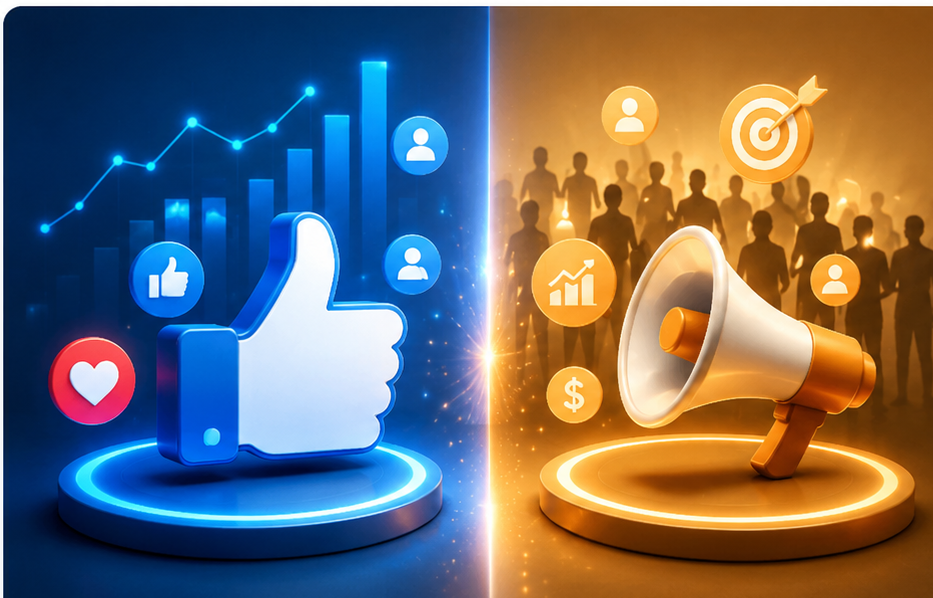
Facebook Likes vs Boosted Ads
Facebook Likes vs Boosted Ads.Every business with a Facebook Page eventually faces the same pressure: the page looks quiet, engagement is low, and growth feels slow. Two options usually surface as a fix. One is to buy Facebook likes to make the page look more established. The other is to run boosted ads through Facebook’s own advertising system to reach a targeted audience.
Both cost money. Both promise growth. But when it comes to actual return on investment — revenue, leads, or business results you can measure — they are not remotely comparable. This guide breaks down what each option actually delivers, what it costs beyond the price tag, and which one holds up when the goal is real business ROI.
Defining the Two Approaches
Before comparing ROI, it’s worth being precise about what each option actually involves, since they work in fundamentally different ways.
Buying Facebook Likes
This refers to third-party services that sell Page likes in bulk, typically sourced from bot accounts, click-farm workers paid to like large batches of pages, or inactive accounts repurposed for this purpose. The transaction happens outside Facebook’s own advertising system, and the accounts liking your page generally have no genuine interest in your business.
Boosted Ads (Facebook Likes vs Boosted Ads)
This refers to Facebook’s official paid promotion tools, which let you pay to display your posts or Page to a defined, targeted audience based on demographics, interests, location, and behavior. This is a sanctioned, transparent system built directly into the platform, with full analytics on who saw and interacted with your content.
The distinction matters because ROI depends entirely on whether the engagement you’re paying for comes from real people who might actually become customers.
How ROI Should Actually Be Measured
Before diving into each option, it helps to define what “ROI” means in this context. For a business, ROI isn’t just about how a page looks — it’s about tangible outcomes:
- Website traffic and clicks
- Leads generated (form fills, messages, calls)
- Sales or conversions
- Cost per lead or cost per acquisition
- Long-term customer value from people who found you through the page
A page with a high like count but no measurable business outcomes has poor ROI, regardless of how impressive the number looks. Keeping this definition in mind is essential for comparing the two options honestly.
Buy Facebook Likes: What You’re Actually Paying For
The Appeal
A higher like count can create an impression of popularity and social proof. For a new business page with very few likes, a boosted number might reduce the “nobody’s here” feeling for first-time visitors.
What It Doesn’t Deliver
No targeting. Purchased likes come from whoever the provider sources them from — there’s no ability to target your actual customer base, location, or interests. A local bakery in Karachi could end up with likes from accounts with no connection to the region, the industry, or any genuine interest in food businesses.
No engagement. Bot and click-farm accounts don’t comment, share, message your page, click through to your website, or make purchases. The core actions that actually drive business value are absent by definition.
No traffic or leads. Since these accounts have no genuine interest in your business, they generate zero website visits, phone calls, or inquiries — the actual outcomes ROI is meant to measure.
Algorithm risk. Facebook’s algorithm evaluates engagement rate relative to your total following. A page with a large like count but very low engagement can see its organic reach to real fans suppressed, because the algorithm interprets the mismatch as a signal that content isn’t resonating.
Policy risk. Meta’s platform policies prohibit the use of services that artificially inflate likes, followers, or engagement. Pages that rely heavily on this practice risk having fake likes purged during platform audits, which causes visible drops in like count over time, and in more serious cases can affect a Page’s standing or ad account eligibility.
The ROI Verdict:Facebook Likes vs Boosted Ads
Because purchased likes generate no real traffic, leads, or sales, the return on that spend is effectively zero from a business outcomes standpoint — the money buys a number, not a customer.
Boosted Ads: What You’re Actually Paying For Facebook Likes vs Boosted Ads
The Appeal
Boosted ads let you pay to put your content in front of a defined audience likely to be interested in your business, with transparent, detailed performance tracking.
What It Delivers
Real targeting. You can define your audience by location, age, interests, behaviors, and even custom audiences built from your existing customer data or website visitors. A local business can target people specifically within delivery range or service area — something purchased likes can never offer.
Genuine engagement. Because the people seeing your ad are real, targeted users, any likes, comments, shares, clicks, or messages generated are authentic signals of interest, not hollow numbers.
Measurable outcomes. Meta Ads Manager provides detailed metrics: reach, click-through rate, cost per click, cost per lead, conversions, and more. This lets you directly calculate ROI rather than guessing based on a vanity number.
Retargeting capability. Boosted ads and broader Meta Ads campaigns allow retargeting — showing ads again to people who already engaged with your page, visited your website, or added items to a cart, which typically produces stronger conversion rates than cold outreach.
Compounding organic benefit. Facebook Likes vs Boosted Ads
Genuine engagement generated through ads (real comments, shares, follows) contributes positively to your organic reach and algorithm standing, unlike purchased likes, which typically hurt it.
What to Watch For
Facebook Likes vs Boosted Ads
Boosted ads aren’t automatically profitable just because they’re legitimate. Poorly targeted campaigns, weak creative, or unclear calls to action can still result in wasted spend. ROI on ads depends on:
- How well-defined your target audience is
- The quality and relevance of your ad creative and offer
- Your landing page or destination experience
- Ongoing monitoring and optimization based on performance data
Unlike purchased likes, though, boosted ads give you the data needed to identify what’s not working and adjust — a feedback loop that simply doesn’t exist with fake engagement.
The ROI Verdict
Boosted ads carry real cost and require some skill to run effectively, but because they reach genuine, targeted users and provide transparent performance data, they offer the potential for measurable, positive ROI — something purchased likes structurally cannot provide.
Side-by-Side Comparison
| Factor | Buy Facebook Likes | Boosted Ads |
| Audience targeting | None | Detailed (location, interests, behavior) |
| Engagement authenticity | Bot/click-farm, no real interest | Real users, genuine interaction |
| Website traffic generated | None | Trackable, measurable |
| Leads/sales potential | None | Direct and measurable |
| Performance data | None | Full analytics via Ads Manager |
| Algorithm impact | Can suppress organic reach | Can support organic reach |
| Policy risk | Violates platform terms | Fully sanctioned |
| Retargeting capability | Not possible | Available |
| Long-term brand value | Minimal to none | Builds real audience relationship |
Why the Comparison Isn’t Actually Close
It’s tempting to frame this as two similarly priced options with different pros and cons, but the honest comparison is more lopsided than that. Buying likes optimizes for a number that doesn’t translate into business value. Boosted ads optimize for reaching real people who can become customers, with data to prove whether it’s working.
The only scenario where purchased likes might feel appealing is short-term, low-stakes vanity — a personal page where the count itself is the only goal. For any business trying to generate leads, sales, or measurable growth, that scenario doesn’t apply.
How to Get Better ROI From Boosted Ads
Since boosted ads are the option capable of producing real ROI, it’s worth outlining how to actually get good results from them, rather than assuming any ad spend automatically performs well.
Define a Specific, Narrow Audience
Broad, generic targeting tends to waste budget on people unlikely to convert. Narrowing by location, interests, and behavior — especially for local or niche businesses — typically produces better cost-per-result.
Lead With a Clear Offer or Value Proposition
Ads that clearly communicate what the viewer gets (a discount, a free consultation, a specific product benefit) tend to outperform vague brand-awareness posts when the goal is measurable ROI.
Use Strong, Scroll-Stopping Creative
Since Facebook is a visual, fast-scrolling environment, ad creative needs to capture attention within the first second or two — clear imagery or video, minimal clutter, and a straightforward message.
Send Traffic to a Relevant, Fast-Loading Destination
Whether it’s a landing page, a Messenger conversation, or a lead form, the destination should match what the ad promised and load quickly — mismatches or slow pages are a common source of wasted ad spend.
Test and Optimize Based on Data
Running small test budgets across a few audience segments or creative variations, then scaling what performs best, is one of the most reliable ways to improve ROI over time.
Use Retargeting Strategically
People who’ve already engaged with your page, watched a video, or visited your website are typically far more likely to convert than a cold audience — retargeting campaigns often deliver the strongest ROI in a broader ad strategy.
When a Business Might Still Consider Buying Likes
To be fair and complete: some businesses buy likes purely for a short-term visual impression — for example, a brand-new page that wants to avoid looking empty during a launch period. If that’s the only goal, and the business fully understands there’s no expected traffic, leads, or sales attached to that spend, the risk may feel acceptable. But it should be understood as a cosmetic decision, not a growth or ROI strategy, and weighed against the platform policy risk and potential organic reach suppression outlined above.
Final Thoughts for Facebook Likes vs Boosted Ads
When the question is specifically about ROI, the comparison between buying Facebook likes and running boosted ads isn’t a close call. Purchased likes produce a number with no connection to real business outcomes, no targeting, and real risk to your page’s algorithmic health and policy standing. Boosted ads, when run with clear targeting, strong creative, and ongoing optimization, reach real people and produce measurable results — traffic, leads, and sales you can track and improve over time.
For any business genuinely trying to grow — not just appear bigger — boosted ads remain the option capable of delivering actual return on the money spent.
Frequently Asked Questions :Facebook Likes vs Boosted Ads
Do boosted ads guarantee a positive ROI?
No. ROI on boosted ads depends on targeting quality, creative, offer strength, and ongoing optimization — but unlike purchased likes, ads provide the data needed to identify and fix what’s not working.
Can buying Facebook likes hurt my page’s performance?
Yes, it can. A mismatch between a large like count and low engagement can signal to Facebook’s algorithm that content isn’t resonating, which can suppress organic reach even to genuine followers.
Is boosting a post the same as running a full ad campaign?
Boosting a post is a simplified version of Facebook advertising, generally used for quick visibility. Full campaigns through Ads Manager offer more advanced targeting, objectives, and optimization options.
How much should a small business budget for boosted ads?
Budgets vary widely by industry and goals, but starting with a modest test budget across a few audience segments is a common way to identify what performs best before scaling spend.
Is it ever worth buying likes for a brand-new page? I
t can be used purely for a short-term cosmetic effect on a new page, but it should not be treated as a growth or ROI strategy, since it generates no traffic, leads, or sales.


